Now that Democrats Have Won Virginia’s Redistricting Vote, the Real Fight Begins


Politics
/
April 27, 2026
The party needs to pursue major reforms to defeat the structural demographic inequities threatening democracy.
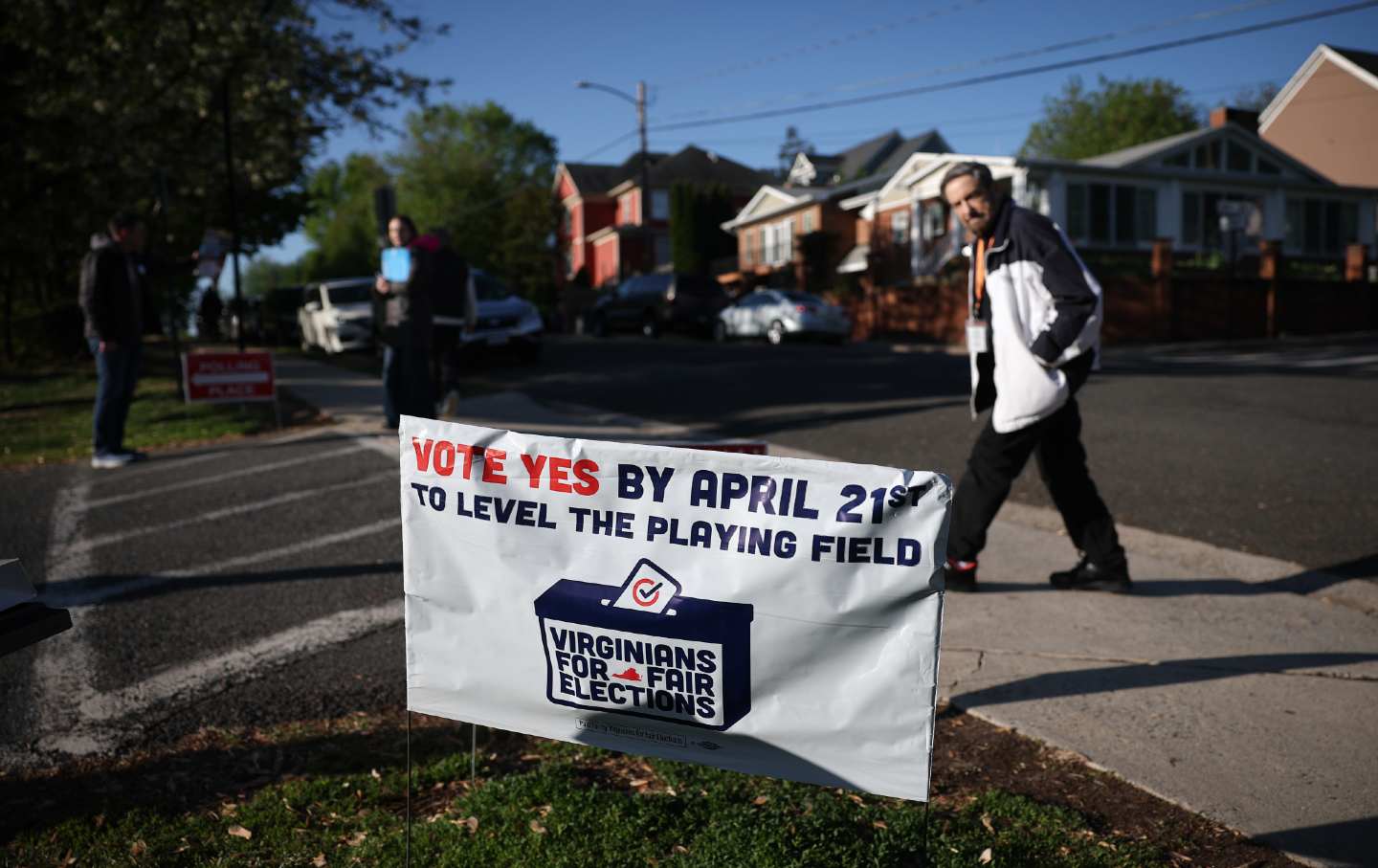
A yard sign urges passage of Virginia’s redistricting referendum.
(Win McNamee / Getty Images)
When Republicans looked like they would engineer a massive midterm advantage by stealing House seats via mid-decade redistricting, Democrats didn’t wring their hands and whine about the unfairness of it all. They strapped on boxing gloves and punched back, winning retaliatory gerrymanders in California and Virginia to even the score.
Now “fuck around and find out” memes abound on Bluesky. The New Republic declared that Virginia is where Donald Trump’s mid-decade redistricting scheme “came to die.” Even Minority Leader Hakeem Jeffries, the very portrait of rule-following, institutionalist Realpolitesse, proclaimed an era of “Maximum warfare, everywhere, all the time.”
It’s undeniably heartening to see leading Democrats accepting the need for procedural hardball, but nothing actually died in Virginia. The mid-decade redistricting wars were not fought to a truce. They are just getting started, at the Supreme Court and in red states nationwide. And the strategy that worked in the early innings – picking off red seats in California and Virginia to compensate for Texas, Ohio, North Carolina and Missouri – won’t be enough from here.
Aside from their rhetorical Patton impersonation, it’s not clear that Jeffries and his colleagues have zeroed in on the right enemy or grasp the limited window for meaningful action before them. Retaliatory gerrymanders that level the playing field for 2026 won’t last. Democrats cannot win one election and then preside over a placid return to normalcy; the Biden years should have made that lesson clear.
The Virginia and California gerrymanders have been framed around beating Trump and checking his authoritarian impulses. He’s a playground bully. You fight back by punching him in the nose. (The Iranians have absorbed this lesson quickly, even if countless American universities, broadcasters, law firms and corporations haven’t.) Yet Trump will soon depart, unpopular and weak. When he is gone, Republicans will still command half the Senate, enjoy new Electoral College and U.S. House advantages after the 2030 census, and control the Supreme Court into at least the 2050s – unless Democrats both win and act.
The problem is larger than Trump, and goes deeper than winning the 2026 midterms. It is the entire GOP authoritarian project, which has hijacked representative democracy through gerrymanders, geographic skews, and deep structural inequities. And this assault on equal ballot access has been enforced by a right-wing supermajority on the Supreme Court won after years of relentless focus and Leonard Leo and Mitch McConnell’s unapologetic constitutional hardball.
Current Issue

If Democrats are serious about responding in kind, they need to tether their new fighting spirit to a reform agenda that takes on the interconnected threats to democracy. The plan has to begin with them winning trifecta power in 2028, using it to remake institutions hijacked by the right—and using this power to weather the shifts in political demography ahead. A baseline set of reforms would include a House based on proportional representation, either packing or limiting the jurisdiction of the Supreme Court, and a serious look at U.S. Senate malapportionment. None of this will be possible without ending the Senate filibuster—something that even these radicalized Republicans, goaded relentlessly by their senescent mad king, have refused to do.
After all, the current redistricting armageddon didn’t start when Trump demanded Texas hand the GOP five additional seats. It began years before Trump, when Republican strategists recognized that winning state legislatures in the 2010 midterms would allow them to install extreme gerrymanders in purple states nationwide that could stifle demographic waves and majority will. The right’s ideological seizure of the voting map then metastasized when Chief Justice John Roberts and the GOP Supreme Court closed the federal courts to partisan gerrymandering claims in 2019, incentivizing politicians to draw the most advantageous maps possible, and leaving voters with little recourse.
And it is Roberts and the Republican supermajority that will have the last word this year. A looming Supreme Court decision in Callais v. Louisiana, a major Voting Rights Act case, could reshape the map even further to the advantage of the GOP. In practical terms, the Court appears poised to rule that states can no longer be required to draw districts that ensure Black and Latino voters can elect candidates of their choice. That would free states like Alabama, Louisiana, Mississippi and South Carolina to redraw their maps in ways that dilute minority voting power—potentially eliminating, in a worst-case scenario, as many as 19 Democratic-held seats across the South, according to Fair Fight Action.
Whenever the Court detonates Callais – and it would be a classic Roberts move to eviscerate the Voting Rights Act, but dust the Court’s fingerprints by postponing the consequences until 2028 – Democrats will need to find double-digit pickups of their own to maintain just the current map. New York, which currently elects 19 Democrats and seven Republicans, will be the first target. Efforts are also under way in Colorado to unwind the state’s independent commission to draw up congressional districts and allow Democrats the opportunity to redraw the map there before 2028; they could certainly craft an 8-0 map given the opportunity. Maybe Democrats even look to have another shot at redistricting in California next year, and draw a 52-0 map that does away with the remaining four GOP seats. That map certainly exists in a strategist’s desk in Sacramento.
Republicans will not only have the boost from the Supreme Court, but can also revisit seats they left on the table in 2026: Indiana and Kansas, as well as Kentucky and New Hampshire, if they hold a state-level trifectas there. It will also be helpful if Democrats could regard gubernatorial elections in places like Texas as equal in importance to high-profile Senate races.
If 2028 sounds bad, things only get more complicated after that. There’s a bloodbath looming after the 2030 census. California, New York, Illinois, Rhode Island, and Minnesota are all losing population and will likely lose House seats after reapportionment. Those seats – and Electoral College votes – will move from states drawn by Democrats to states drawn by Republicans, including multiple new districts in Texas and Florida. The hypothetical 2028 gains in California and New York gains would be temporary. If Democrats don’t have a serious strategy to face this major demographic shift before 2031, they will face an even harder road to the House and the White House beginning in 2032.
Popular
“swipe left below to view more authors”Swipe →
A national U.S. House map this gerrymandered by both sides is a travesty—deeply antidemocratic and wildly dangerous. By 2028, it is entirely possible that the number of competitive House districts nationwide could shrink into the single digits. That’s an awful prospect for voters, and a near death sentence for responsible governance. Mass governance by gerrymander puts ideologues in power from nonresponsive districts and makes it nearly impossible to dislodge them.
The far right election-denial caucus also didn’t begin with MAGA and Trump. It took hold, and began to exert power, after the 2012 elections—the first conducted on new maps dramatically shaped by the successful 2010 Republican gerrymandering strategy called REDMAP. That effort was driven by the Republican party establishment, but it created a Frankenstein monster that instantly brushed it aside–thereby launching the conditions for the GOP’s MAGA takeover.
Democrats are understandably focused on the 2026 midterms. If you listen closely to Democratic leaders, you’ll find nearly all of them still invested in the folk belief that Republicans will back down from extreme redistricting if Democrats decide that they will do it as well. Sixteen years into REDMAP rule, that represents a grievous misreading of the moment and the stakes. Republicans have no reason to back down. The coming Callais decision, the seats they still left on the table, and the post-2030 apportionment all mean that the numbers are on their side. They have zero incentive to stop.
We need big structural approaches to fix big structural problems. Such an initiative would begin with a more proportional House, with larger districts impossible to gerrymander anywhere, modeled along the Fair Representation Act. If Democrats can’t be persuaded to do that, then at least they can uncap the number of House seats and ensure that states don’t “lose” seats every ten years; instead, they could ensure that a new welter of House districts would permit the national legislature to grow as the architects of the Constitution intended.
The Court must also be enlarged, term-limited and returned to being a court once again, rather than a veto-proof supermajority of nine with lifetime appointments and the power to time retirements to select their ideological successors. Admitting additional states or some method of reapportionment must also expand the Senate given that under current estimates, 70 percent of all Americans will live in 15 states by the end of the 2030s, represented by just 30 senators.
None of this change—all of it in service of restoring majority rule and fair representation—can pass without ending the filibuster. Democratic leaders are understandably reluctant to push for filibuster abolition as long as it is the only thing standing in the way of the SAVE Act and countless other pieces of toxic legislation that have passed the House and are stalled in the Senate. They will also have to steel themselves to do what is necessary over the howls of a Beltway political class that assumes Democrats must forever be the “normal” party playing by the rules while their adversaries gleefully hack every loophole in the constitutional order. Many Democrats understood these stakes when they held a narrow trifecta from 2021 to 2023, but it wasn’t enough to get major reforms done. They cannot afford to fail again.
You can outmaneuver a bully for a cycle or two. You cannot outlast a system designed to entrench power. By 2029, Democrats may have a brief chance to do more than fight back—they may be able to rewrite the rules of the game itself. If they leave the current political order in place, with its antiquated rules, counter-majoritarian institutions and built-in structural disadvantages, the maps will tighten, the courts will hold, and the window will close. And once that happens, the question won’t be whether Democrats can win elections. It will be whether elections can still meaningfully change who governs at all.
From illegal war on Iran to an inhumane fuel blockade of Cuba, from AI weapons to crypto corruption, this is a time of staggering chaos, cruelty, and violence.
Unlike other publications that parrot the views of authoritarians, billionaires, and corporations, The Nation publishes stories that hold the powerful to account and center the communities too often denied a voice in the national media—stories like the one you’ve just read.
Each day, our journalism cuts through lies and distortions, contextualizes the developments reshaping politics around the globe, and advances progressive ideas that oxygenate our movements and instigate change in the halls of power.
This independent journalism is only possible with the support of our readers. If you want to see more urgent coverage like this, please donate to The Nation today.
More from The Nation
In this week’s Elie v. US, our justice correspondent deconstructs Patel’s preposterous defamation arguments. Plus: a fascinating gun-control lawsuit. And: All hail The Onion!
Elie Mystal

The president and the defense secretary are being humiliated abroad, so they’re purging scapegoats at home.
Jeet Heer

A decorated Army veteran, a Working Families Party candidate and a longtime liberal politician and activist make the Democratic primary in Hudson Valley’s CD-17 riveting.
Joan Walsh

The Trump brand is tarnished, and his grip over the GOP is loosening—but his authoritarian ambitions have not yet been corralled.
Column
/
Sasha Abramsky


