NVIDIA claims DLSS 5 will deliver ‘photoreal’ image quality with AI this fall

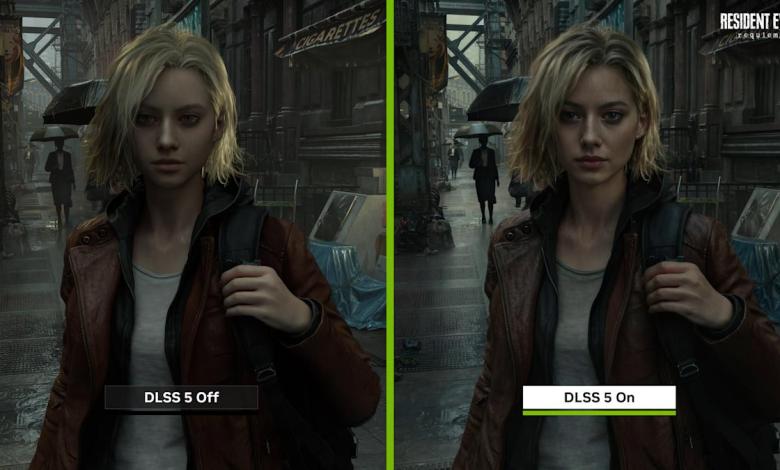
Just months after announcing DLSS 4.5 at CES, NVIDIA has revealed its next major upscaling technology, DLSS 5. The company is doubling down on AI for this next iteration, saying DLSS 5 “imbues pixels with photorealistic lighting and materials” using a real-time neural rendering model when it arrives this fall.
So what does this mean in practice? During an on-stage demonstration during NVIDIA’s GTC 2026 keynote, CEO Jensen Huang demonstrated the technology with Resident Evil: Requiem, Hogwarts Legacy And Star field. DLSS 5 adds a noticeable amount of detail to the character’s hair and skin tone, but it also seems like it’s being compared to those games without any DLSS features enabled. It’s unclear what difference this makes compared to DLSS 4.5 with path tracing and all its features enabled.
“DLSS 5 takes a game’s color and motion vectors as input for each frame and uses an AI model to infuse the scene with photorealistic lighting and materials that are anchored to the source 3D content and consistent from frame to frame,” NVIDIA said in a blog post. The company also notes that the technology works in real time and that it works up to 4K.
Huang demonstrated DLSS 5 while running a system with two RTX 5090 GPUs. Eventually, it will be able to run on a single video card (although I imagine it should be almost as powerful as two 5090s). Huang also describes DLSS 5 as a step toward Hollywood-style real-time rendering quality, without needing the GPU power required by studios. This is a bit like a generative AI video model that can be directly controlled by developers, instead of just AI prompts.
NVIDIA, never shy of self-aggrandizement, claims that DLSS 5 is also the “biggest advancement in computer graphics” since real-time ray tracing arrived in 2018. But given that ray tracing itself is not common for many gamers, it will be interesting to see if there is interest in the pixels produced by NVIDIA’s AI.


