Pompeii House Frozen Mid-Renovation Reveals Secrets of Roman Cement


December 9, 2025
2 min reading
 Add us on GoogleAdd SciAm
Pompeii time capsule reveals secrets of durable ancient Roman cement
Lime granules trapped in ancient walls show that the Romans relied on a reactive hot-mixing method to make concrete that could now inspire modern engineers.

The so-called Ferreres Aqueduct, also known as Puente del Diablo, is a Roman arcade that is part of the aqueduct that supplied water from the Francolí River to the town of Tarraco (Tarragona), a distance of 25 kilometers.
Sergi Reboredo/VW Pics/Universal Images Group via Getty Images
The ancient Romans built arched bridges, watertight port infrastructure and aqueducts that enabled the growth of their empire and which are still standing and often still in use. They did this with a much stronger type of cement than that used today, but exactly how Roman cement was made remained a mystery. Researchers have now found evidence for an explanation they proposed in 2023 that could provide insight into how to build more sustainable concrete today.
In his work from the first century BCE Of Architecture, Vitruvius, one of the Roman Empire’s most famous architects, described Roman cement as being made from what we today call slaked lime, or hydrated and heated limestone. But based on the discovery of the composition of pieces called “lime chips” found during a previous excavation at Pompeii, Massachusetts Institute of Technology environmental engineer Admir Masic and his colleagues proposed in a 2023 paper that ancient builders instead used a process called “hot mixing.” In this method, highly reactive quicklime (dry-heated limestone) is mixed with volcanic ash and water, triggering a chemical reaction that produces heat and gives the material self-healing capabilities.
To reaffirm his discovery, Masic and his team returned to Pompeii in 2024 and visited a house that was being renovated when Mount Vesuvius erupted, freezing the place in time. “I literally felt like I was a 79 EC worker,” Masic says.
Inside one of the rooms, among the stones, tiles and tools, researchers found large piles of dry, premixed mortar ingredients — a mixture of volcanic ash and quicklime granules — waiting to be hydrated and applied to the walls, Masic said.
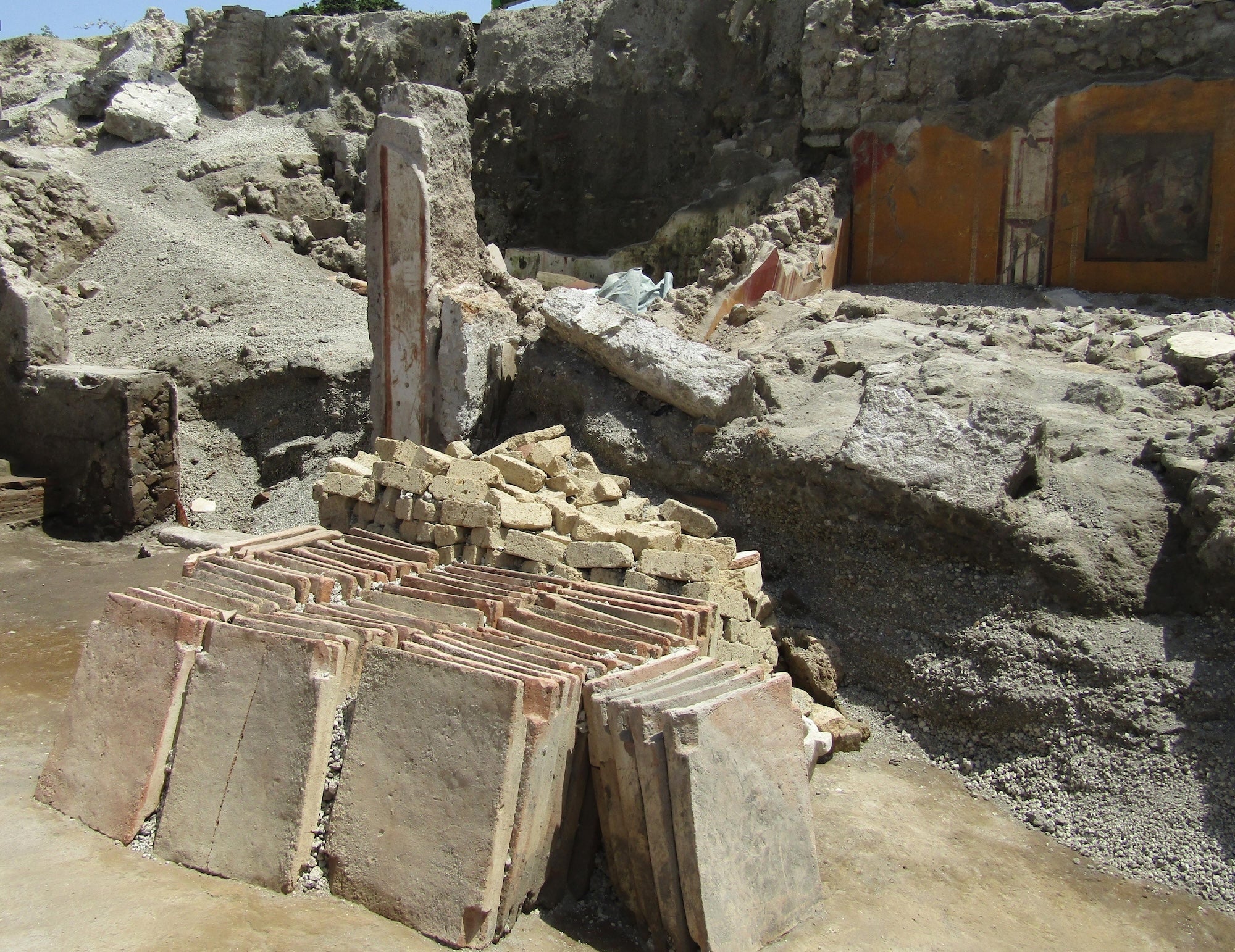
Rows of ceramic tiles and a stack of yellow tuff blocks in Atrium 2 of the recently excavated Regio IX (Pompeii Archaeological Park), showing materials prepared for ongoing reconstruction work.
Pompeii Archaeological Park
The team also showed that the lime fragments – previously thought to be impurities from an incomplete mixture – had distinctive physical and chemical characteristics that could only be produced by a technique in which water was added to the mixture of quicklime and ash, not by the method described by Vitruvius. The researchers published their results Tuesday in Natural communications.
The hot mixing method creates fragmented, highly porous lime clasts in the mortar that allow calcium to easily travel through the material and recrystallize to fill cracks. Understanding and mastering this “self-healing” technology will allow engineers to use this technique in modern construction. Modern cement is made by heating limestone and clay in giant kilns to form a material called clinker, which is ground into a powder and mixed with water on site to make concrete. It is strong but short-lived, often cracking and degrading within a few decades.
The results will also allow restorers to repair the remains of the Roman Empire with a more compatible approach. “We’ll definitely have some new restaurant recipes coming out of this,” Masic says.
“Few topics in Roman archeology deserve our attention as much as the development of concrete,” says archaeologist Tom Brughmans of Aarhus University in Denmark, who was not involved in the study. The new research is “simply a beautiful observation, an archaeologist’s dream.”
It’s time to defend science
If you enjoyed this article, I would like to ask for your support. Scientific American has been defending science and industry for 180 years, and we are currently experiencing perhaps the most critical moment in these two centuries of history.
I was a Scientific American subscriber since the age of 12, and it helped shape the way I see the world. SciAm always educates and delights me, and inspires a sense of respect for our vast and magnificent universe. I hope this is the case for you too.
If you subscribe to Scientific Americanyou help ensure our coverage centers on meaningful research and discoveries; that we have the resources to account for decisions that threaten laboratories across the United States; and that we support budding and working scientists at a time when the value of science itself too often goes unrecognized.
In exchange, you receive essential information, captivating podcasts, brilliant infographics, newsletters not to be missed, unmissable videos, stimulating games and the best writings and reports from the scientific world. You can even offer a subscription to someone.
There has never been a more important time for us to stand up and show why science matters. I hope you will support us in this mission.


