Remnants of ancient galaxy called ‘Loki’ found inside the Milky Way


Astronomers have identified strange stars in the Milky Way that may once have belonged to another galaxy.
By studying the chemistry of these stars and their movement near the galactic disk, researchers discovered that these stars’ home galaxy, nicknamed “Loki”, could have merged with our galaxy around 10 billion years ago.
Massive galaxies are not born whole. They are assembled over billions of years by merger with smaller, sometimes absorbed, galaxies. In the early universe, shortly after the Big Bangmatter grouped together into clouds of gas that collapsed into the first primitive galaxies. These small systems then blended into each other, merged, and gradually built up to form the large structures we know today.
In the new study, published March 23 in the Monthly Notices of the Royal Astronomical SocietyAstronomers identified 20 ancient, very metal-poor stars orbiting unusually close to the galactic disk – the flat, rotating region of the Milky Way where most stars, including the Sun, reside – and examined whether a past merger could explain what they were seeing.
A chemical timestamp
The very first stars formed in the universe were made of hydrogen and helium. Only inside these first stars did hydrogen and helium coalesce into heavier elements, which astronomers call metals. These stars, when they eventually exploded, enriched the surrounding gas with these metals. Each successive generation of stars is therefore born from slightly more enriched material than the previous one.
As these small galaxies collided and merged, their stars, gas and dark matter became part of the young, growing Milky Way. For this reason, computer simulations suggest that stars from early mergers should be found deeper inside the Milky Way today, while stars from galaxies that merged later are more likely to be scattered further into the galactic halo – a vast spherical region that extends beyond the bright disk.
However, very few metal-poor stars have been discovered in the inner regions of the Milky Way to test this idea. So when the team identified 20 metal-poor stars orbiting near the galactic disk, they wondered whether these stars could be the remnants of an ancient merger.
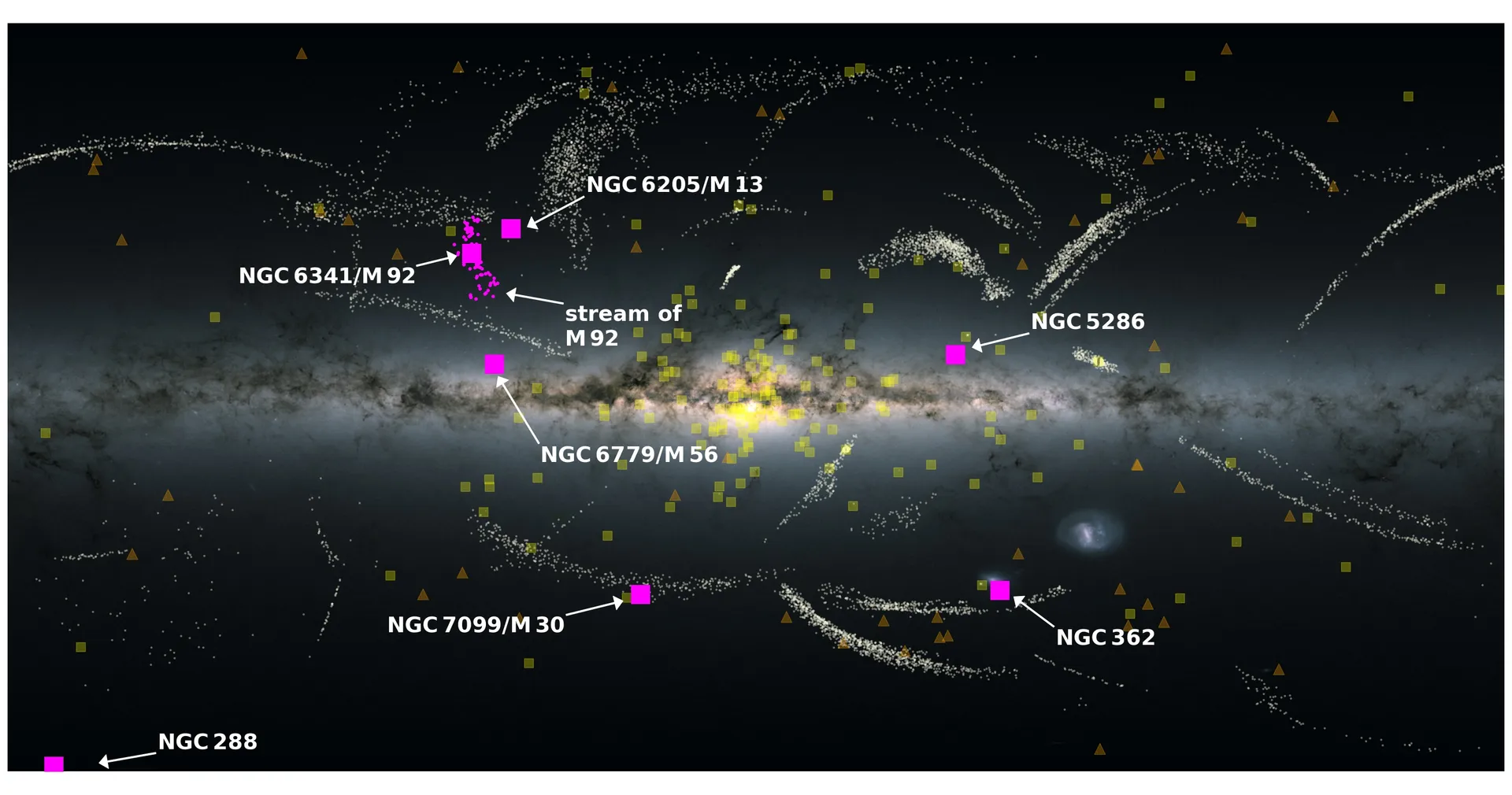
The Milky Way is suspected to have merged with a dozen or more dwarf galaxies during its 12 billion year history. This map from the Gaia telescope shows in purple the locations of star clusters from suspected mergers.
(Image credit: ESA/Gaia/DPAC)
Hide and seek
The team identified these stars from an existing catalog of metal-poor stars. They observed each of them using a powerful spectrograph on the Canada-France-Hawaii telescope, which revealed their chemical abundance. Using precise position data from the Gaia space telescope, they calculated the distances of stars and their orbits in our galaxy.
Sestito said “a mix of information from the chemistry and orbits of these stars” led them to examine the origin of the stars. Rather than drifting through the galaxy’s halo where old, metal-poor stars were mostly observed, these stars traced trajectories close to the disk of the Milky Way, just 6,500 light-years from the sun.
“Usually disk stars are metal-rich and younger, like the sun,” he said, “while our stars [in the study] are old and very poor in metals (as in dwarf galaxies).”
Additionally, some of these stars were moving in the same direction as the rotation of the Milky Way, while others were moving in the opposite direction. But these two groups showed no difference in their chemical abundances. Explaining how a single infallible galaxy could let stars move in opposite directions was also a challenge.
The answer came from computer simulations of galaxy formation. If the merger had occurred early enough, when the young Milky Way was still light and had not yet settled into a spinning disk, the falling galaxy would have had enough freedom to scatter its stars in all directions.
“The early history of a large galaxy’s merger could be very chaotic, with various smaller systems merging and scattering their stars into many different orbits,” Sestito explained. This scenario could produce both prograde and retrograde orbits, placing the merger event approximately 3 billion years after the Big Bang.
As a result, the simulations showed that a single dwarf galaxy swallowed up by the young Milky Way more than 10 billion years ago could have scattered its stars in exactly the orbital pattern observed today. The models also made it possible to estimate the total mass of this galaxy at around 1.4 billion solar masses.
The team dubbed this Infallible Galaxy Loki.
“Loki, in Norse mythology, is the god of mischief, and as a trickster, his intentions are difficult to decipher,” Sestito said. “Similarly, our accumulated stars have made it difficult for us to understand their origin.”
The search continues
Anirudh Chitian astrophysicist at Stanford University who was not part of the study, told Live Science that the new discovery was promising.
“The analysis of chemical abundance is intriguing, and part of the argument rests on the fact that the chemistry of stars appears more clustered than that of the Milky Way halo,” Chiti wrote in an email. “This is a great example of the type of discovery these samples could reveal or verify.”
Yet the new findings are far from certain. Sestito acknowledged that more observations are needed to confirm them.
“Our work is surely limited in terms of the number of stars observed,” Sestito said. Observing stars with high-resolution spectroscopy is time-consuming: each star requires about four hours of telescope time, which is why the current sample is small.
Since researchers are still in the early stages of exploring the chemical signatures of the least metallic stars in the Milky Way’s disk, it remains plausible that these stars belong to a subgroup of stars or substructure of the Milky Way, Chiti noted. “I look forward to what future work mapping the chemistry of large samples of very metal-poor stars in the Milky Way disk might show,” he said.
To confirm the nature of Loki, the team would need to observe its stars and other non-Loki targets with the same telescope setup to better understand the differences between this system and other parts of the Milky Way halo.
With upcoming advanced spectroscopic facilities, astronomers will be able to observe hundreds of stars with available high-quality data on their trajectories and chemical abundances. Sestito believes that research should not be limited to the halo. Systems hidden in the galaxy’s inner regions could hold clues to the young universe’s primitive galaxies, although detecting them in the cluttered disk would be difficult.
Sestito, F., Fernández-Alvar, E., Brooks, R., Olson, E., Carigi, L., Jofré, P., De Brito Silva, D., Eldridge, CJL, Vitali, S., Venn, KA, Hill, V., Ardern-Arentsen, A., Kordopatis, G., Martin, NF, Navarro, JF, Starkenburg, E., Tissera, PB, Jablonka, P., Lardo, C., . . . Online Amayo, A. (2026). An ancient system hidden in the Galactic Plane? Monthly Notices of the Royal Astronomical Society, 548(2). https://doi.org/10.1093/mnras/stag563


