Researchers Find Evidence of Ancient Microbial Life in 3.51 Billion-Year-Old Rocks


Extracting biochemical information from ancient organic-rich sediments, including the timing of the emergence of photosynthesis relative to inferred oxygenation of the Earth’s atmosphere, remains a challenging opportunity. To address this issue, scientists analyzed 406 ancient and modern samples and used supervised machine learning to distinguish between samples of biogenic and abiogenic origin, as well as photosynthetic and non-photosynthetic physiology. They found chemical evidence of biogenic molecular assemblies in Paleoarchean rocks (3.51 billion years ago) and of photosynthetic life in Neoarchean rocks (2.52 billion years ago).
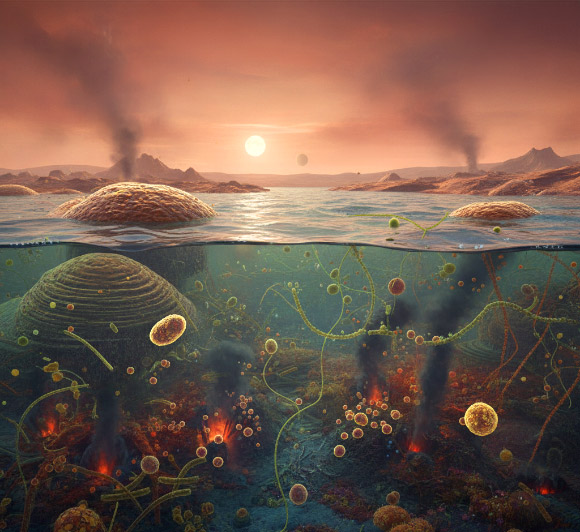
An AI impression of the early Earth. Image credit: Gemini AI.
The first forms of life on Earth left few molecular traces.
The few fragile remains, such as ancient cells and microbial mats, were buried, crushed, heated and fractured in the churning Earth’s crust before being pushed to the surface.
These transformations have virtually erased biosignatures containing vital clues about the origins and early evolution of life.
Paleobiologists searching for signs of the earliest life on Earth have long relied primarily on fossil organisms, including microscopic fossils of single cells and filaments, as well as the mineralized remains of cellular structures such as microbial mats and mound-shaped stromatolites, which provide compelling evidence of life dating back 3.5 billion years. However, these remains are rare.
A second source of data relies on the preservation of diagnostic biomolecules in ancient rocks.
Life’s toughest organic molecules – those derived from cell membranes or certain metabolic processes – have been found in 1.7 billion-year-old sediments, while much older, carbon-rich rocks preserve isotopic signatures that suggest a vibrant biosphere 3.5 billion years ago.
However, most ancient rocks do not retain any surviving fossil cells or biomolecules.
The vast majority of ancient carbonaceous sediments were heated and modified in ways that broke each diagnostic biomolecule into countless small fragments.
These fragments proved too small and too generic to provide clues about ancient life – until now.
“Ancient rocks are full of interesting puzzles that tell us the story of life on Earth, but there are always a few missing pieces,” said Katie Maloney, a researcher at Michigan State University and co-author of the study.
“Combining chemical analysis and machine learning has revealed biological clues about ancient life that were previously invisible.”
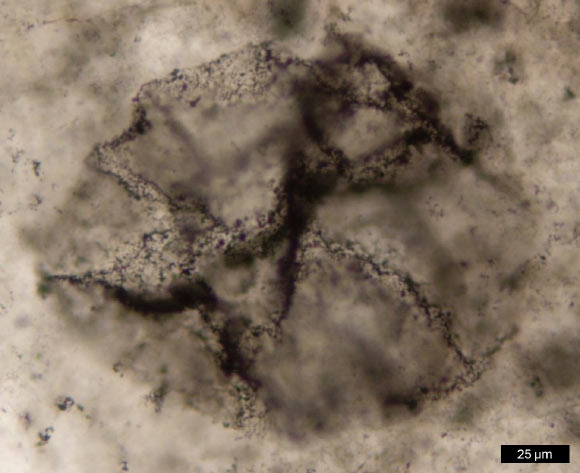
Organic matter extracted from 2.5 billion-year-old rock samples containing fossilized microorganisms like the one in this photomicrograph still contains biomolecular fragments that may have been produced by photosynthesis. Image credit: Andrew D. Czaja.
The researchers used high-resolution chemical analysis to break down organic and inorganic materials into molecular fragments, then trained an AI system to recognize the chemical “fingerprints” left by life.
They examined a total of 406 fossil, modern biological, meteoritic and synthetic samples.
The AI model distinguished biological from non-biological materials with over 90% accuracy and detected the first biomolecular evidence for:
(i) the photosynthetic origins of organic molecules in the 2.52 billion year old Gamohaan Formation, Campbellrand Group, South Africa, and the 2.30 billion year old Gowganda Group, Ontario, Canada;
(ii) the biogenicity of organic molecules preserved in the 3.51 billion year old Singhbhum craton in India; the 3.33 billion-year-old Josefsdal chert from the Barberton Greenstone Belt, South Africa; and the 2.66 billion-year-old Jerrinah Formation, Fortescue Group, Pilbara Craton, Australia;
(iii) and the apparently non-photosynthetic origin of organic species in the 3.5 billion-year-old Theespruit Formation of the Barberton Greenstone Belt, South Africa, and the 3.48-billion-year-old Dresser Formation of the Pilbara Craton, Australia.
“Ancient life leaves behind much more than fossils; it leaves behind chemical echoes,” said lead author Dr. Robert Hazen, a researcher at the Carnegie Institution for Science.
“Thanks to machine learning, we can now interpret these echoes reliably for the first time.”
“This innovative technique helps us read the deep-time fossil record in a new way,” added Dr. Maloney.
“This could help guide the search for life on other planets.”
“Understanding when photosynthesis arose helps explain how Earth’s atmosphere became rich in oxygen, a key step that allowed complex life forms, including humans, to evolve,” said first author Dr. Michael Wong, also of the Carnegie Institution for Science.
“This represents an inspiring example of how modern technology can shine a light on the planet’s oldest stories and could reshape how we search for ancient life on Earth and other worlds.”
“In the future, we plan to test materials such as anoxygenic photosynthetic bacteria, possible analogues of extraterrestrial organisms. This is a powerful new tool for astrobiology.”
“These samples and the spectral signatures they produce have been studied for decades, but AI offers a powerful new lens that allows us to extract critical information and better understand their nature,” added Dr. Anirudh Prabhu of the Carnegie Institution for Science, co-author of the study.
“Even when degradation makes it difficult to detect signs of life, our machine learning models can still detect the subtle traces left by ancient biological processes.”
“What’s exciting is that this approach does not rely on the discovery of recognizable fossils or intact biomolecules.”
“AI not only helped us analyze data faster, it also allowed us to make sense of messy and degraded chemical data.”
“This opens the door to exploring ancient and extraterrestrial environments with a new perspective, guided by patterns we may not even know to research on our own.”
The team’s results appear this week in the Proceedings of the National Academy of Sciences.
_____
Michael L. Wong and others. 2025. Organic geochemical evidence for life in Archaean rocks identified by pyrolysis-GC-MS and supervised machine learning. PNAS 122 (47): e2514534122; doi: 10.1073/pnas.2514534122

:max_bytes(150000):strip_icc()/Health-GettyImages-1060820524-b9fd002a2a4b4506b7fbeafed4361931.jpg?w=390&resize=390,220&ssl=1 "Common Tongue Conditions in People With HIV")


