Smallpox eradication champion William Foege dies at age 89


January 26, 2026
2 min reading
 Add us on GoogleAdd SciAm
Scientist who helped eradicate smallpox dies at 89
Leader in the global fight against smallpox and champion of vaccine science, William Foege died last Saturday.
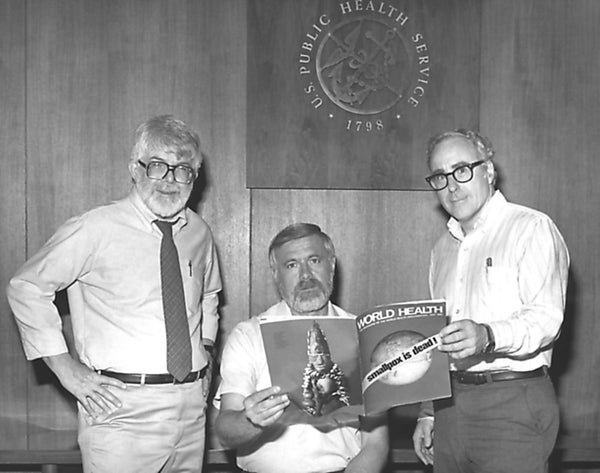
The late physicians and healthcare administrators William Foege (medium), J. Donald Millar (LEFT) and J. Michael Lane (RIGHT), all of whom participated in the Global Smallpox Eradication Program in 1980.
CDC/Smith Collection/Gado/Contributor/Getty
William Foege, a leader in the global fight against smallpox, has died. Foege died Saturday at the age of 89, according to the Task Force for Global Health, a public health organization he co-founded.
Foege led the U.S. Centers for Disease Control and Prevention’s smallpox eradication program in the 1970s. Before the disease was officially eradicated in 1980, it killed about one in three infected people. According to the CDC, there have been no new cases of smallpox since 1977.
“If you look at the simple measure of who saved the most lives, he’s at the top of the pantheon,” former CDC Director Tom Frieden told the Associated Press. “The eradication of smallpox prevented hundreds of millions of deaths. »
On supporting science journalism
If you enjoy this article, please consider supporting our award-winning journalism by subscription. By purchasing a subscription, you are helping to ensure the future of impactful stories about the discoveries and ideas shaping our world today.
Foege later headed the CDC and served as senior medical advisor and principal investigator at the Bill & Melinda Gates Foundation. In 2012, President Barack Obama awarded him the Presidential Medal of Freedom.
Foege was a strong advocate of vaccines for public health, writing with epidemiologist Larry Brilliant in Scientific American in 2013, that efforts to eliminate polio “have never been closer” to success. “By working together,” they wrote, “we will soon relegate polio – alongside smallpox – to the history books.” » Polio remains a “candidate for eradication,” according to the World Health Assembly.
And in 2025, Foege, alongside several other former CDC directors, spoke out against the policies of current Health and Human Services Secretary Robert F. Kennedy, Jr. New York Times In an opinion piece, they wrote that the top health official’s mandate was “unlike anything we’ve ever seen at the agency.”
In a statement, Patrick O’Carroll, CEO of the Global Health Task Force, recalled Foege as an “inspiring” figure, both for early-career public health workers and veterans in the field. “Every time he spoke, his vision and compassion reawakened the optimism that led us to choose this field and reinvigorated our efforts to make this world a better place,” O’Carroll said.
It’s time to defend science
If you enjoyed this article, I would like to ask for your support. Scientific American has been defending science and industry for 180 years, and we are currently experiencing perhaps the most critical moment in these two centuries of history.
I was a Scientific American subscriber since the age of 12, and it helped shape the way I see the world. SciAm always educates and delights me, and inspires a sense of respect for our vast and beautiful universe. I hope this is the case for you too.
If you subscribe to Scientific Americanyou help ensure our coverage centers on meaningful research and discoveries; that we have the resources to account for decisions that threaten laboratories across the United States; and that we support budding and working scientists at a time when the value of science itself too often goes unrecognized.
In exchange, you receive essential information, captivating podcasts, brilliant infographics, newsletters not to be missed, unmissable videos, stimulating games and the best writings and reports from the scientific world. You can even offer a subscription to someone.
There has never been a more important time for us to stand up and show why science matters. I hope you will support us in this mission.