Sniffer dogs tested in real-world scenarios reveal need for wider access to explosives


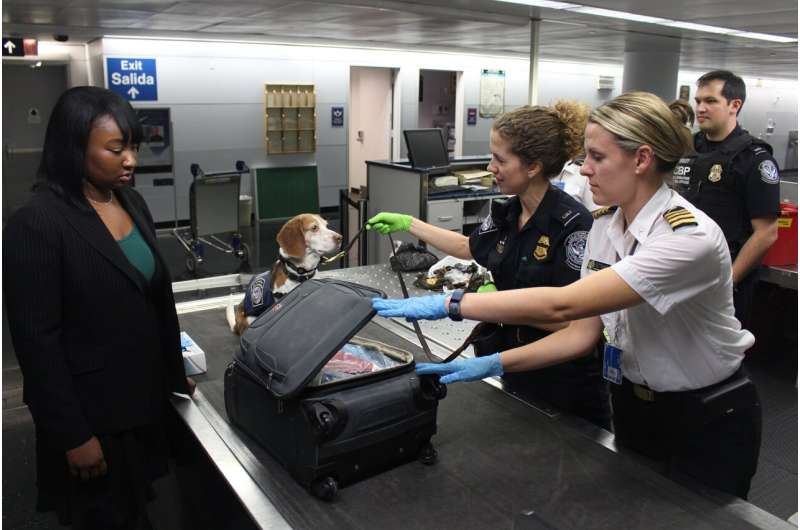
Credit: Unsplash/CC0 Public domain
Dogs are not only our best friends, they are also key allies in the fight against terrorism. Thousands of explosive detection dog teams and their handlers work 24/7 at airports, mass transit systems, cargo facilities and public events around the world to keep us safe. But canine detection is as much an art as a science: success depends not only on the skill of the dog and human, but also on their bond, and can vary depending on their physiological state and environmental conditions.
Practices are often passed down informally between managers, which can further undermine consistent performance across teams. To address this, the American Academy of Forensic Science Academy Standard Board (ASB) published a new American standard in 2021. Titled “Standard 092 for Training and Certification in Canine Explosives Detection,” this standard was added to the OSAC registry in 2022.
But does he keep his promise? This is what a team of American researchers set out to discover. They published their findings in Frontiers of Veterinary Science.
“We show here that the performance of canine teams in the new official assessment is indeed informative, in the sense that it can predict their performance in real-world scenarios,” said Dr. Lauryn E DeGreeff, associate professor at the Global Forensic and Justice Center at Florida International University.
“However, we also show that passing the assessments remains a challenge, and we have recommendations for improving training to make it easier to meet the criteria.”
Work like a dog
Between July 2024 and May 2025, DeGreeff and his colleagues tested 56 teams of dogs and handlers at an undisclosed office building, university and prison in the southwest, southeast and west of the United States. The dogs were females and males ranging in age from 2 to 10 years old and belonging to eight different breeds, including German Shepherds, Malinois, Labradors and German Shorthaired Pointers.
Each dog/handler team was tested over two days in up to 19 trials, including official “092 standard” evaluations and real-world scenarios. Six types of explosives were tested, separately or in combination.
An example of the first challenge involved detecting 115 g of explosive in an odor-permeable jar inside a room, with identical jars containing air (a “blank”) and steak seasoning, conditioner, and coffee grounds (“distractions”). One real-life scenario was a vehicle search, where 4 ounces of another explosive and 24 inches of fuse wrapped in plastic had to be found among empty wrappers and wrapped Play-Doh.
Performance on Standard 092 assessments and in real-world scenarios was correlated: teams that did well in the former tended to do well in the latter, and vice versa. This is the first step towards successful validation of the new standard, which shows that these assessments measure meaningful aspects of performance, which can be extrapolated globally.
However, the trials proved very difficult for the teams, and none currently met the official OSAC requirements of successfully detecting 90% of explosives with a false alarm rate of less than 10%. Performance depended on the region, the day of testing and the type of explosive tested, and varied greatly between teams. The top eight teams achieved a detection rate of 79-86%, with a false alarm rate of 7-14%.
One assessment that proved particularly difficult was the plot searches, where teams had to locate two explosives hidden in a row of 10 boxes, in accordance with Standard 092. The dogs also found it more difficult when the boxes were taped shut than when they were simply folded. They showed the highest rate of false alarms when sharp objects and anti-static bags were used as distractions.
Old dogs learn new tricks
“We found that limited access to explosive training materials and training opportunities was the main challenge for teams and explained much of the geographic variation observed in the data,” said Dr. Paola A Prada-Tiedemann, second corresponding author and associate professor at Texas Tech University.
Many handlers expressed excitement about participating because it allowed them to work with explosive materials and research scenarios that they did not have regular access to.
“The trial helped Gimmy and I get to know each other better and provided a good practice/trial to see where we are as a team,” said Gimmy’s English Labrador handler, Geoff.
German Shepherd Odin’s handler Toni added: “It’s always a valuable experience for me and my dog to train in new places, encounter new smells and work in different contexts. I also appreciate the opportunity to support the scientific community in advancing research that benefits the K9 community. »
More information:
Explosive detection canines in the field: a multi-site black box validation study, Frontiers of Veterinary Science (2025). DOI: 10.3389/fvets.2025.1668317
Quote: Sniffer dogs tested in real world scenarios reveal need for wider access to explosives (October 16, 2025) retrieved October 16, 2025 from https://phys.org/news/2025-10-sniffer-dogs-real-world-scenarios.html
This document is subject to copyright. Except for fair use for private study or research purposes, no part may be reproduced without written permission. The content is provided for informational purposes only.


