Sound of Rain May Help Plant Seeds Decide When to Grow


New experiments with rice suggest that acoustic vibrations from falling droplets can stimulate the growth of dormant seeds, providing the first direct evidence that plants can perceive natural sounds.
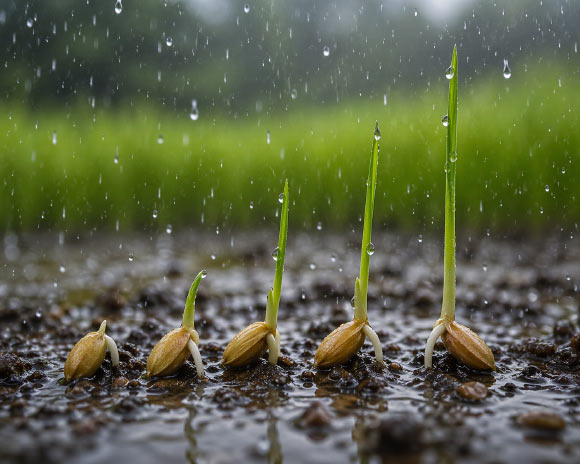
Rice and related seed types can detect the sound of rain hitting the ground or water surface above them and respond by accelerating germination to depths where the impulsive sound of rain is intense enough to intermittently shake statoliths from contact with cell membrane receptors and trigger gravitropic growth mechanisms.
Plants are surprisingly perceptive. To help them survive, plants have evolved to sense and respond to stimuli in their environment.
Some plants close when touched, while others curl inward when exposed to toxic odors.
And of course, most plants respond to light and move toward the sun to help them grow.
Plants can also sense gravity. A plant’s roots grow downward, while its shoots resist the pull of gravity.
Plants sense and respond to gravity using their statoliths.
Statoliths are denser than a cell’s cytoplasm and can drift and flow through the cell, like a bit of sand in a pot of water.
When a statolith finally settles to the bottom, its location on the cell membrane reflects the direction of gravity and indicates where a root or shoot of a seed should grow.
If the statolith is dislodged, scientists have found that this can also trigger increased growth of the seed.
“What our study says is that seeds can detect sounds in a way that can help them survive,” said Professor Nicholas Makris of MIT.
“The energy of the sound of rain is enough to accelerate the growth of a seed.”
Professor Makris and his colleague Cadine Navarro, a researcher at MIT, carried out experiments with rice seeds, which grow naturally in shallow water fields.
In a large number of repeated experiments, they submerged about 8,000 individual rice seeds in shallow trays of water and exposed sections of them to drops of water.
They varied the size and height of each water droplet to mimic raindrops during light, moderate and severe thunderstorms.
The researchers also used a hydrophone to measure the acoustic vibrations created underwater by the water droplets.
They compared these measurements to recordings made in the field, for example in puddles, ponds, wetlands and soils during thunderstorms.
The comparisons confirmed that their water droplets in the laboratory generated rain-induced acoustic vibrations, as in nature.
By observing rice seeds, the authors found that groups of seeds exposed to the sound of water were able to germinate 30 to 40 percent faster than groups of seeds that were not exposed to the sounds of rain but were otherwise under identical conditions.
They also found that seeds closer to the surface could detect droplet sounds better and grow faster than seeds that were more submerged or further away.
These experiments showed that there is a link between the sound of a water droplet and the ability of a seed to grow.
The researchers suggest that seeds that can detect rain may have a biological advantage: If they are close enough to the surface to respond to the sound of rain, they are likely at an optimal depth to absorb moisture and grow safely to the surface.
The team then performed calculations to see if the physical vibrations of the droplets would be enough to jostle the seeds’ microscopic statoliths.
If so, this would indicate the mechanism by which sound can directly stimulate a plant’s growth.
In their calculations, the scientists took into account the size and terminal velocity of a rain droplet (the constant speed that a falling object ultimately reaches) and calculated the amplitude of sound vibration that the droplet would generate.
From there, they determined the extent to which these vibrations in the water or soil would move or shake a submerged or buried seed, and how a shaken seed would affect the microscopic statoliths of individual cells.
The authors found that the experiments they carried out on rice seeds were consistent with their calculations: the sound of rain can indeed dislodge and jostle the statoliths of a seed.
This mechanism is likely responsible for a plant’s ability to “feel” the sound of rain and grow in response.
“Brilliant research has been carried out around the world to reveal the mechanisms behind plants’ ability to sense gravity,” Professor Makris said.
“Our study showed that these same mechanisms appear to provide plant seeds with a way to perceive submergence depths in soil or water that are beneficial to their survival by detecting the sound of rain.”
“This gives new meaning to the fourth Japanese micro-season, titled Falling rain wakes the ground.”
An article describing this research was published this week in the journal Scientific reports.
_____
NC Makris and C. Navarro. 2026. Seeds accelerate germination at beneficial planting depths by detecting the sound of rain. Scientific representative 16, 11248; doi: 10.1038/s41598-026-44444-1


