Trump says nuclear weapons testing to resume in US after more than 30 years


President Donald Trump has called on U.S. military leaders to resume nuclear weapons testing to keep pace with other countries like Russia and China.
“Due to other countries’ testing programs, I have asked the War Department to begin testing our nuclear weapons on an equal basis,” he wrote on social media just before his meeting with Chinese President Xi Jinping in South Korea.
The United States has more nuclear weapons than any other country, Trump said, followed by Russia and China, “third by far.” It has not carried out any nuclear tests since 1992.
This comes just days after Trump denounced Russia for testing a nuclear-powered missile. The Kremlin says its tests were “not nuclear.”
Later, on Air Force One, after the two leaders met, Trump said nuclear test sites would be determined later.
“As others are testing, I think it’s appropriate that we do that as well,” Trump said upon his return to Washington.
No country except North Korea has conducted a nuclear test this century, according to the Arms Control Association (ACA) – and even Pyongyang announced a moratorium in 2018.
Trump’s announcement did not clarify whether he was referring to a nuclear explosion test or simply a weapons system capable of delivering a nuclear weapon.
In his message Wednesday evening, he acknowledged the “tremendous destructive power” of nuclear weapons, but said he had “no choice” but to update and renovate the U.S. arsenal during his first term.
He also said that China’s nuclear program “will be balanced within 5 years.”
The announcement marks an apparent reversal of long-standing U.S. policy. The last US nuclear test took place in 1992, before former Republican President George HW Bush imposed a moratorium at the end of the Cold War.
Russia announced this weekend that it had successfully tested two new weapons capable of carrying nuclear warheads.
These included a missile that the Kremlin said could penetrate US defense systems, and an underwater drone called Poseidon, capable of striking the US west coast and unleashing radioactive ocean waves. But these tests did not involve the detonation of nuclear weapons.
On Thursday, Russia denied carrying out nuclear tests.
“Regarding the Poseidon and Burevestnik tests, we hope that the information was conveyed correctly to President Trump,” Kremlin spokesman Dmitry Peskov told reporters. “This cannot in any way be interpreted as a nuclear test.”
The Kremlin said the United States had not informed Russia of its intention to conduct nuclear weapons tests.
“The United States is a sovereign country that has the right to make its sovereign decisions. But I would like to recall President Putin’s statement, which has been repeated many times: if anyone deviates from the moratorium, Russia will act accordingly,” the spokesperson said.
China also responded to Trump’s announcement, saying it hoped the United States would seriously fulfill its obligations under the Comprehensive Nuclear Test Ban Treaty (CTBT) and honor its commitment to suspend nuclear testing.
Who has the most nuclear weapons?
Trump said the United States has more nuclear weapons than any other country.
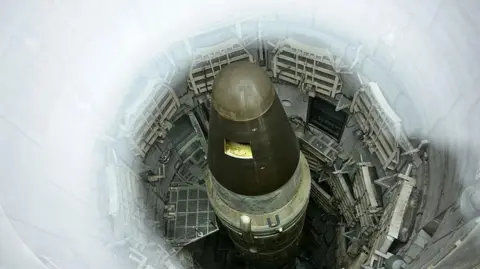
The exact number of nuclear warheads held by each country is kept secret in each case – but Russia reportedly has a total of about 5,459 nuclear warheads, while the United States has about 5,177, according to the Federation of American Scientists (FAS).
The US-based ACA gives slightly higher estimates, saying the US nuclear stockpile stands at around 5,225 nuclear warheads, while Russia has around 5,580.
China is the third nuclear power with around 600 nuclear warheads, France has 290, the United Kingdom 225, India 180, Pakistan 170, Israel 90 and North Korea 50, FAS reports.
According to the American think tank Center for Strategic and International Studies (CSIS), China has almost doubled its nuclear arsenal over the past five years and is expected to exceed 1,000 weapons by 2030.
Trump’s statement on nuclear testing came about 100 days before the New Strategic Arms Reduction Treaty (New Start) expires in February 2026 – the last nuclear weapons treaty between the United States and Russia.
The deal limits each country to 1,550 nuclear warheads on deployed missiles capable of crossing continents.

 Getty Images
When and where was the last American test held?
The last time the United States tested a nuclear bomb was on September 23, 1992. The test took place at an underground facility in the western state of Nevada.
The project, named Divider, is the 1,054th nuclear weapons test by the United States, according to the Los Alamos National Laboratory, which played a central role in the development of the world’s first atomic bomb.
The Nevada test site, located 65 miles north of Las Vegas, is still operated by the U.S. government.
“If deemed necessary, the site could be reauthorized for nuclear weapons testing,” according to the National Museum of Nuclear Science and History, affiliated with the Smithsonian Institution.
But some experts note that it would take at least 36 months for the United States to resume underground nuclear testing at the former Nevada Test Site.
“Trump is misinformed and out of touch,” Daryl G Kimball, executive director of the ACA, wrote on
“Trump will unleash strong public opposition in Nevada, from all of America’s allies, and this could trigger a chain reaction of nuclear testing by America’s adversaries and destroy the Nuclear Non-Proliferation Treaty,” Kimball added.
Trump’s announcement also drew backlash from some opposition Democrats. Rep. Dina Titus of Nevada wrote on X: “I will introduce legislation to stop this.”
The United States first entered the nuclear age with the Trinity test of the first atomic bomb in July 1945 in the Alamogordo Desert, New Mexico.
Japan later became the only country in the world to use nuclear weapons in war after dropping two atomic bombs on the Japanese cities of Hiroshima and Nagasaki in August of the same year, during World War II.
Around 140,000 people were killed in Hiroshima and 74,000 in Nagasaki, with many deaths due to the immediate effects of the explosion, burns and later radiation sickness.


