Why dad never looked like his parents



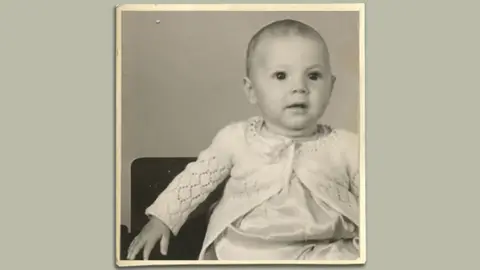 Family photo
Matthew’s father had brown eyes and black hair. His grandparents had piercing blue eyes.
There was a common joke in his family that “dad did not look like his parents,” said the teacher in the south of England.
It turned out that there was a very good reason for that.
Matthew’s father had been exchanged at the hospital almost 80 years ago. He died at the end of last year before learning the truth of his family history.
Matthew – Not her real name – contacted the BBC after reporting the case of Susan, who received compensation from an NHS Trust after a home DNA test revealed that she was accidentally changed for another baby in the 1950s.
BBC News is now aware of five cases of babies mistakenly exchanged in maternity rooms from the late 1940s to the 1960s.
Lawyers say they expect more people manifesting themselves by increasing inexpensive genetic tests.
‘The old joke could be true after all’
During the pandemic, Matthew began to look for answers to insignificant questions about his family history. He sent a saliva sample to the position to be analyzed.
The genealogy company has entered its file in its vast online database, allowing it to see other users whose DNA corresponded closely to their own.
“Half of the names I have never heard of,” he says. “I thought:” It’s weird “, and I called my wife to tell her that the old family joke could be true after all.”
Matthew then asked her father to submit his own DNA sample, which confirmed that he was even more closely linked to the same group of mysterious family members.
Matthew started to exchange messages with two women who suggested the site were his father’s cousins. All were confused about how they could be linked.
Working together, they finally found birth files from 1946, months after the end of the Second World War.
The documents showed that one day after the birth of his father, another little boy had been recorded in the same hospital in eastern London.
This boy had the same relatively unusual surname which appeared on the mystery branch of the family tree, a link confirmed later by the birth certificates obtained by Matthew.
It was a moment of bulb.
“I immediately realized what should happen,” he said. “The only explanation that was logical was that the two babies got into the hospital.”
Matthew and the two women managed to build a brand new family tree based on all of his DNA matches.
“I love a puzzle and I like to understand the past,” he says. “I am completely obsessive anyway, so I started trying to try backwards what had happened.”
 Hulton Archive / Getty Images
An era before the bracelets
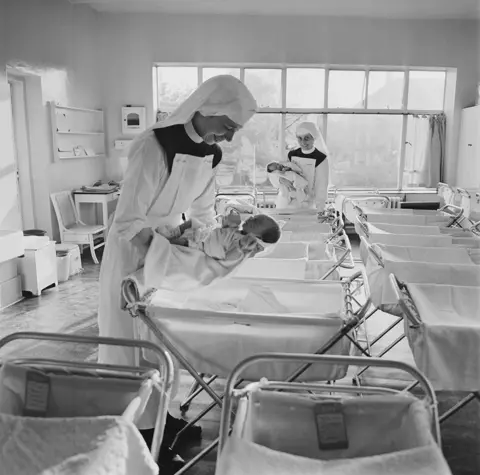
Before the Second World War, most babies in the United Kingdom were born at home or in nursing homes, assisted by midwives and the family doctor.
It started to change when the country was preparing for the launch of the NHS in 1948, and very gradually, more babies were delivered to the hospital, where newborns were generally withdrawn during the periods to be taken care of in the nursery.
“The baby would be removed between the flows so that the mother can rest, and the baby could be watched by a nurse or a midwife,” said Terra Coates, a lecturer of the midwife, and a former clinical adviser in the BBC series calls the midwife.
“It may seem paternalistic, but the midwives thought they were incredibly taking care of mothers and babies.”
It was common for new mothers to be kept in hospital for between five and seven days, much longer than today.
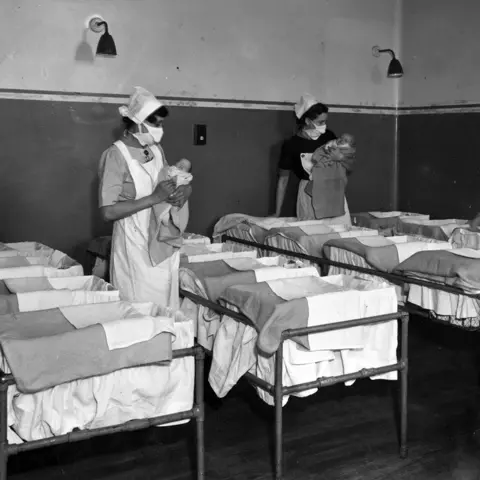
To identify newborns in the nursery, a card would be linked to the end of the bed with the name of the baby, the name of the mother, the date and time of the birth and the weight of the baby.
“Where the courses rather than the babies were labeled, accidents could easily occur,” explains Ms. Coates, who formed as an infirmish herself in the 1970s and a midwife in 1981.
“If there were two members or more members of the nursery staff who fed babies, for example, a baby could easily be placed in the bad bed bed.”
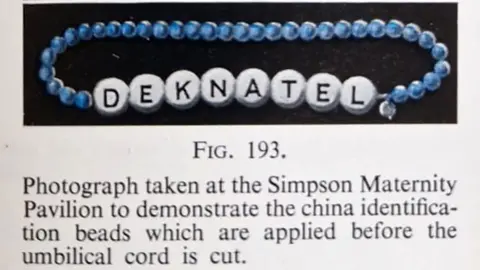
In 1956, the births of the hospital became more and more common and the midwife manuals recommended that a “wrist name” or a “chain of porcelain pearls” should be attached directly to the newborn.
A decade later, in the mid -1960s, it was rare for babies to be removed from the delivery room without being labeled individually.
 Manual for midwives, 1956
The stories of babies accidentally changed to the hospital were very rare at the time, although others are now occurring thanks to the boom of genetic tests and ascending websites.
The day after Jan Daly’s birth in a hospital in northern London in 1951, his mother immediately complained that the baby was given to him was not his.
“She was really stressed and cried, but the nurses assured her that she was wrong and the doctor was called to try to calm her down,” explains Jan.
The staff fell only when her mother told them that she had fast and not assisted delivery and underlined the brands of clear pliers on the baby’s head
“I have been feeling for the other mother who had fed fortunately for two days and then had to abandon a baby for another,” she said.
“There was never excuses, it was only” one of these stupid mistakes “, but the trauma affected my mother for a long time.”
 Hulton Archive / Getty Images
Never to discover
Matthew’s father, an insurance agent from countries of origin, was an passionate amateur cyclist who spent his life following the local race scene.
He has lived alone in retirement and in the past decade, his health has deteriorated.
Matthew has long thought of telling him the truth about his family history but, in the end, decided not to do it.
“I just felt that my father didn’t need it,” he said. “He had lived 78 years in a type of ignorance, so he didn’t feel good to share it with him.”
Matthew’s father died last year without ever knowing that he would celebrate his birthday a day earlier in the past eight decades.
Since then, Matthew went to the West Country to meet the genetic cousin of his father and daughter for a coffee.
They all got along well, he said, sharing old photos and “filling pieces of family history”.
But Matthew decided not to contact the man with whom his father had to be exchanged as a baby, or his children – in part because they did not do DNA tests themselves.
“If you do a test by sending your saliva, there is an implicit understanding that you could find something that is a bit of a surprise,” said Matthew.
“While with people who haven’t done it, I still don’t know if it’s the right thing to contact them – I don’t think it’s just to drop this bomb.”


