Why hoarding 4K remuxes is a massive storage trap


I’ve been using a Plex server for a long time, which means I’ve made my share of amateur mistakes. Storage is probably one of the biggest issues plaguing my Plex server, and I’ve definitely made these three mistakes at least once (if not multiple times).
Use older, more inefficient containers or codecs
H.265/HEVC is life
When I started building my Plex library, H.264 was the gold standard. Everything was H.264. Nowadays, there are much more efficient codecs that can still maintain the same video quality but with a much smaller file size.
While AV1 is the new benchmark for retention quality with the smallest file size, H.265 (HEVC) is the ideal solution. It is supported by most modern systems and takes up approximately 50% less space than H.264 at the same quality.
As an example, a 20GB H.264 Blu-ray rip would probably only take between 8GB and 12GB in H.264 with negligible quality loss (if you can even notice quality loss). Imagine if you have 100 movies in your library, that’s 1TB of storage space saved without degrading the quality of the movies at all.
If you don’t know where to start converting your library, there are tools like Tdarr that can do it for you. I used Tdarr to convert my huge Plex library to H.265 and saved about 7TB of space. Of course, the best option is to re-rip all your media to H.265 from the source instead of transcoding them, but that takes time and a lot of manual work: Tdarr (or other similar tools) are completely free and automated.
Keeping Movies or TV Shows You Haven’t Watched in Years
And probably never will

We’ve all been there: There’s a movie or TV series that you checked out years ago in your Plex library and watched once, but never planned to watch again. This media takes up valuable space on your Plex server that could be used by something else.
There are automated tools, like Ensureerr, that can select your library for you based on whether or not it meets certain criteria. Running something like Ensureerr is a great way to keep your library clean and tidy without lifting a finger, but I don’t actually use it in my own Plex setup.
Instead, I simply manually select my library as needed. Whenever my Plex library starts to get too big, I go through it and watch what I don’t really want to watch anymore. Maybe there’s something I recently added to the library that I don’t actually intend to look at, or there might be something that’s been around for years that I want to look at and then delete.
No matter how you handle it, keeping movies or TV shows that haven’t been watched in years is simply a waste of space if you’re short on storage.
I think you need all movies in 4K HDR
Can you actually tell the difference between 1080p and 4K from your couch?

At one point I kept a Plex 4K and 1080p library on my server. I did this to avoid having to transcode on the fly, as it was simply easier to have copies of 4K and 1080p movies to watch. Eventually I realized I was sitting about 13 feet from my mid-range TV and simply couldn’t tell any difference in quality between a decent 1080p Blu-ray rip and a full 4K Blu-ray remux.
Once I realized this, I simply deleted almost all of the 4K content I had in Plex, freeing up a pretty impressive amount of space. You see, full 4K remux rips can take up 100GB of storage or more per movie. This means that only 10 movies could fit in 1TB of storage. So my 72TB server could only hold 720 movies if there was nothing else on it.
Not all 4K movies are this large, but I’ve had a few in the 90GB+ range, including several well over 100GB. When I finally realized I didn’t need all the movies in 4K HDR, my Plex server gained a lot of space. It’s entirely possible to have a 1080p quality movie in 1-2GB of storage space, with some of my full-length movies taking up 1% of the storage space compared to their 4K HDR counterparts.
- Brand
-
UGREEN
- Processor
-
Intel Core Ultra 7 255H
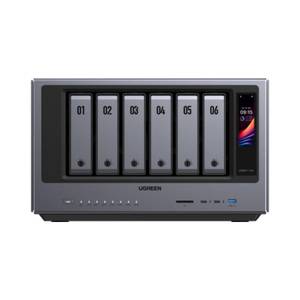
The Ugreen iDX 6011 Pro AI NAS is one of the most powerful NAS servers in the Ugreen range. With the 16-core Intel Core Ultra 7 255H processor and 64GB of LPDDR5/x RAM onboard, there’s more than enough power to handle anything you can throw at this system. Add in two Thunderbolt 4 ports, two 10GbE LAN ports, an OCuLink expansion port, and more, and you have a very solid network attached storage system.
Ultimately, your Plex server will probably never need more storage. Mine has grown several times. When I started there was only 12TB, and now I have 44TB in use and 72TB total on my server (soon to be 80TB once my 8TB replacement drive comes back from warranty service).
If you’re short on storage space, just know that you don’t have to buy more hard drives: you can simply use the tips above to free up space on your existing system to postpone the purchase until prices start to drop.