Why humpback whale rescue effort got called off


A humpback whale nicknamed Timmy, stranded in the Baltic Sea off Germany, will be left for dead; All rescue efforts have been called off, according to Till Backhaus, environment minister of the German state where the whale is now stranded.
The whale, 12 to 15 meters long, found itself stuck on sandbanks on several occasions at the end of March: in one incident, it was freed using an excavator which dug an escape channel, and in another incident, it freed itself. Currently, Timmy is stranded on a small island near the port of Wismar, Germany, in the Baltic. Reports suggest the animal, believed to be male but whose sex has not been fully confirmed, is exhausted, breathing irregularly and barely moving.
Fabian Ritter, marine biologist and whale advocate, is following the situation in the media and is in regular contact with people on the ground. Scientific Americanthe German-language sister publication Spektrum der Wissenschaft spoke with Ritter about the difficult decision to stop rescue efforts and the changes needed in policy and individual actions in the face of such incidents.
On supporting science journalism
If you enjoy this article, please consider supporting our award-winning journalism by subscription. By purchasing a subscription, you are helping to ensure the future of impactful stories about the discoveries and ideas shaping our world today.
[An edited transcript of the interview follows.]
Experts and others have expressed differing opinions about the whale’s health. Why was this so difficult to assess?
We are mainly dependent on the external signs of the animal’s behavior. Is he breathing regularly and with what force? [is it doing so]? What is [its] what does the skin look like? What is his general condition? These are things that we can only roughly assess. What we do know, however, is that the humpback whale endured weeks of suffering because it was entangled in a fishing net, which certainly weakened it considerably. And there are still pieces of fillet in his mouth, which is why he might not be able to eat even if he wanted to. It is weakening and probably nearing the end of its lifespan.
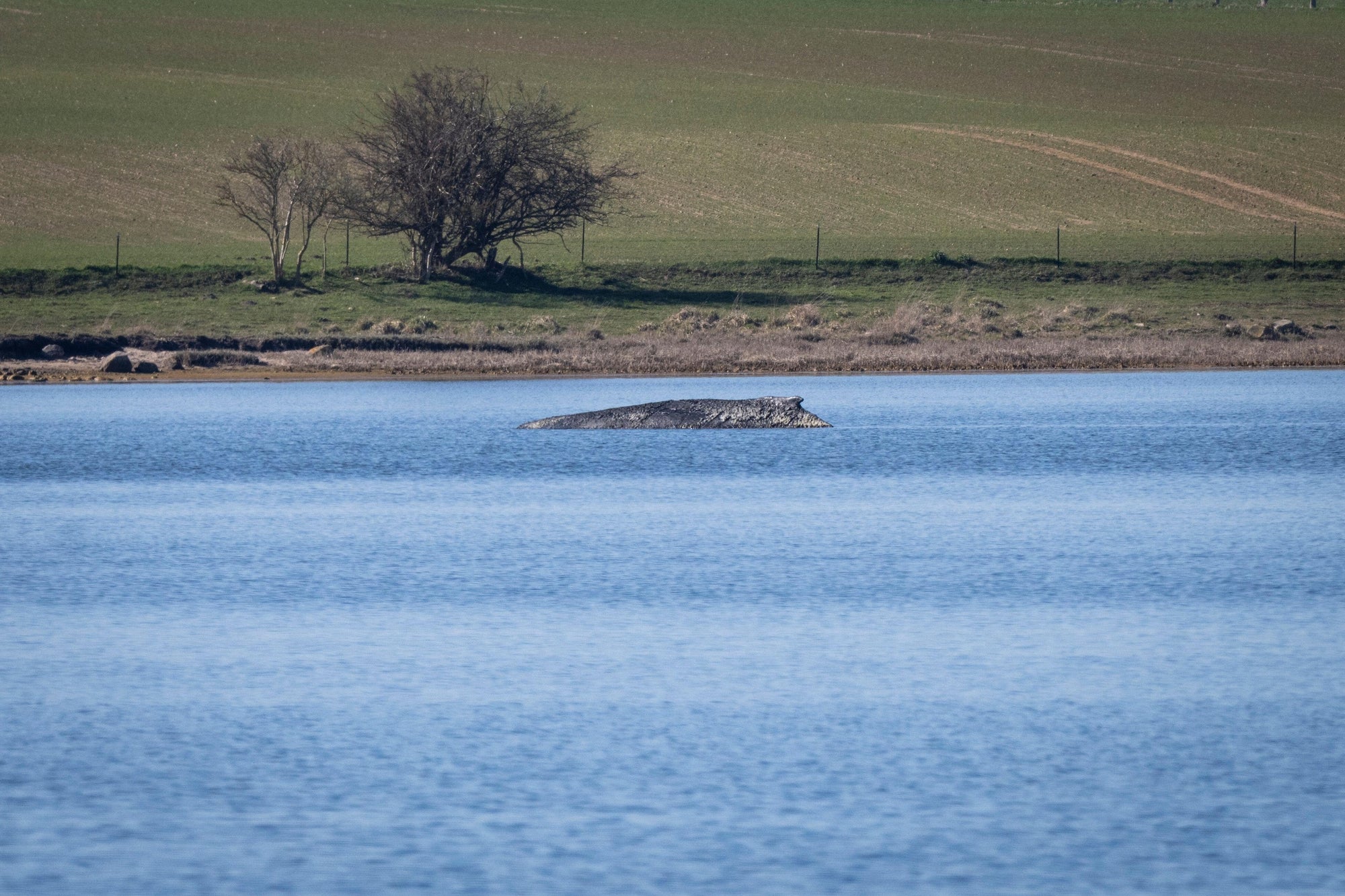
A stranded humpback whale lies off the small island of Poel in the Baltic Sea off Germany, April 1, 2026. Rescue efforts have been halted as the animal is not expected to survive.
Philip Dulian/dpa/Alamy Live News
Throughout this saga, have you seen any encouraging signs that the whale might survive?
Five or six days ago I didn’t give the whale a chance and then was surprised when it broke free again. But my hopes remained low. In the last few days it only did a few laps and then stabilized again. This suggests that he is pretty much at his physical and mental end.
If the whale had reached the open sea, would it be safe?
Had [the whale] I started moving again and swam in the right direction, [it] it would still have taken hundreds of kilometers to reach the Atlantic. It was definitely inside [the whale’s] understand that [the animal] would have found [its] path. But the net in [its] the mouth is probably the origin [it] pain and prevention [it] to eat a lot, or nothing. Ultimately it would be a death sentence no matter how far [it] manages to swim.
What exactly is the next step? Will this marine mammal die naturally? We also talked about euthanasia.
Euthanasia was ruled out by everyone involved. Such an undertaking is too difficult from a logistical point of view, especially because the animal is currently lying on muddy ground. And then there’s the question of how exactly this would be done. There are three possibilities: For example, we could inject a large dose of toxin. But no one knows how much a humpback whale would need. The second option is the use of large caliber firearms. The problem is that the shot would have to be extremely accurate; otherwise the animal would suffer even more. The third option would be an explosive device. Even if it would be the most effective, what would happen if the cameras were rolling? The world would watch. No, that would not be a good solution.
What happens after the death of the marine mammal?
The carcass [will be] transported ashore with heavy equipment and veterinarians [will] examine it carefully: blood tests, internal lesions, levels of pollutants, parasites. Naturally, everyone wants to determine the actual damage caused by the mesh in their mouth or digestive tract. Then the whale must be skinned and disposed of.
How did the whale end up in this predicament? Is there more information on this now?
The main reason is probably the net. We don’t know if [the whale] have become entangled in the Baltic Sea or already in the North Atlantic. If the latter is true, [the animal] arrived weakened and was therefore already in great distress. Another possibility is that [it] ended up in the Baltic Sea as a stray animal, possibly with a pre-existing condition and disorientation. Reasons could include hearing damage from underwater noise. Sometimes humpback whales simply appear in unexpected areas. It is therefore possible [it] was simply curious and ended up in the Baltic Sea for this reason. Such things happen from time to time.
What is the most likely scenario?
[The whale] probably lost. I think it is rather unlikely that [the animal] deliberately swam in the Baltic Sea. What is certain is that when [it] was seen for the first time [in early March]the net was already rolled up [its] body. It certainly did [its] situation worse.
Although the whale was largely freed from the lines, its situation did not improve. Could there be a deeper problem with the whale’s ability to navigate?
The question is: how exactly [it] sailing in the Baltic Sea? Do [it] to use [its] the sense of taste, the earth’s magnetic field, [its] audience? Or does [it] East [itself] by the water temperature? Experts debate which meaning is more important to a baleen whale. The fact is that [this whale] weakens, and with that, [its] the senses diminish. And maybe [it] it also means losing motivation, strength and the ability to decide where to swim.
How do you retrospectively evaluate the measures taken to save the humpback whale?
This is a difficult question. From my point of view, the strategy was sound. Giving the animal periods of rest and then motivating it again was the right approach. The decision to enter the water with it, however, was rather unwise. If you ask whale experts from rescue teams around the world, they will all tell you the same thing: don’t go in the water with the whale, and certainly not alone. A careless move could lead to being struck by a fluke or otherwise injured. There is no simple solution to such situations. The team from the Institute for Terrestrial and Aquatic Wildlife (ITAW), the German Oceanographic Museum and Greenpeace ultimately used a trial-and-error approach to see what could be done. If the whale dies, no member of the rescue team can be blamed afterwards. From the start, the odds were against them.
And what about the decision not to remove the gillnet from the mouth: was it the right decision?
I think they should have tried. When the whale was still there [Timmendorf Strand, Germany]there was at least a chance. But this was only possible with a specialized team and equipment. In hindsight, however, we should think more about what we could do differently in the future to prevent whales from ending up in this situation. After all, it is a very visible and tragic victim of fishing.
What types of political action could help these situations?
Marine conservation organizations working to protect whales have long called for an end to bottom trawling and gillnet fishing, at least in protected areas. These fishing methods destroy habitats and are responsible for horrific bycatch. Every year, 300,000 whales and dolphins die around the world, as do millions of seabirds, not to mention sharks. Thousands of harbor porpoises are killed in nets in Europe every year. And this, despite the fact that it is a strictly protected species.
[Editor’s Note: In U.S. waters, 14 populations of humpback whales are listed as “endangered” under the Endangered Species Act, with protections also provided by the U.S. Marine Mammal Protection Act. Commercial whaling is managed worldwide by the International Whaling Commission.]
How is it possible for fishing to take place in a marine protected area?
We marine conservationists have been asking this question for decades. Fishing is just one use among many [for protected areas]. Shipping, gravel mining, tourism and military exercises also take place in protected areas; some even contain wind farms. It is absurd what is happening today in these so-called protected areas.
Do you see any chance that this current affair will change your mind?
Yes, because the link could not be clearer. Backhaus is now called upon to think seriously about the problem of bycatch in gillnet fisheries. I hope the plight of the lost whale will serve as a wake-up call and motivate people to act. And I’m not just talking about politicians: we are all called to act. Ultimately, with every tuna steak, salmon fillet or cod on our plates, we contribute to the plundering of the oceans. At least this is the case if the fish does not come from an explicitly sustainable fishery or aquaculture.
Isn’t the fact that so many people are affected by the whale’s plight a good sign? Is a shift in values perhaps happening?
I think this could be an opportunity for a change in values. We must recognize that our emotion reveals ambivalence. We are following the fate of the humpback whale with concern, but at the same time we have salmon fillets and sausages lying around in our refrigerators. If the fate of one whale affects us so deeply, the deaths of the 300,000 marine mammals who perished in the nets should also affect us deeply. We urgently need to ask ourselves: how should we treat the oceans and animals? These are indeed deep ethical questions, but the story must be taken to this level. If we translate our compassion into action, the whale’s death will not have been in vain.
This article was originally published in Spektrum der Wissenschaft and has been reproduced with permission. It was translated from the original German version with the help of artificial intelligence and reviewed by our editors.