Bats are seeking sanctuary in churches


Rebecca Morelle,Scientific editor And
Alison François,Senior Science Journalist

 Chris Damant/Bernwood Ecology
This is work that can only be accomplished under the cover of darkness.
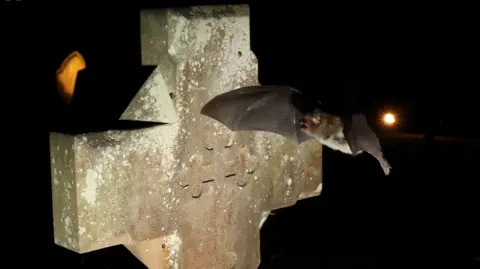
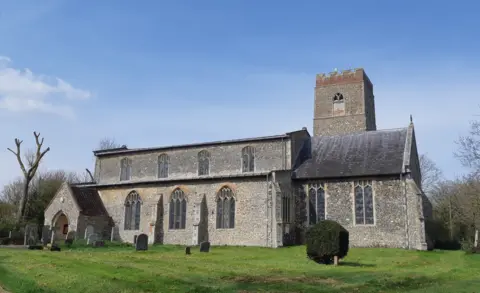
As night falls, bat hunters make their way among the tombstones at Guestwick Church in Norfolk.
The creaking door opens. Inside is the dark and deserted church and the team begins setting up their specialist equipment.
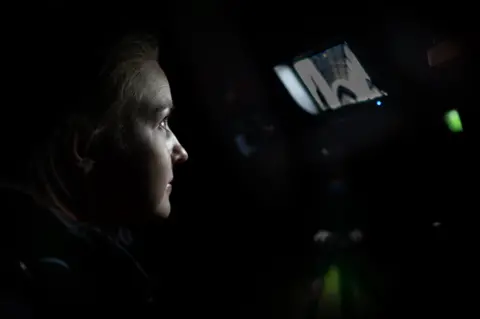
Infrared and thermal cameras are carefully positioned and audio detectors are tuned to bat-friendly frequencies.
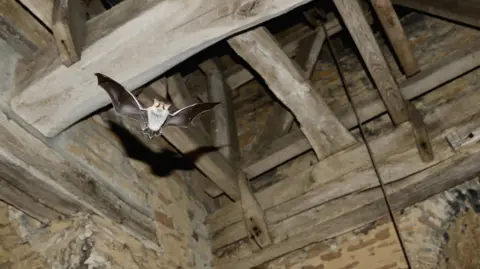
Bats soon begin to emerge, scurrying and diving through the aisles, the amplified sounds of their chatter filling the historic building.
“A lot of these churches have been on these sites for probably 1,000 years, and probably for as long as they’ve been there, they’ve been home to bats,” says Diana Spencer, of the Bats in Churches project.
A new study published in the British Ecological Society’s journal People & Nature has found that these historic buildings provide vital habitat for nocturnal animals.
The research, based on citizen science surveys carried out by the Bat Conservation Trust, estimates that half of all churches in England – more than 8,000 – are home to bats.
And this figure rises to around 80% for older churches.
“They basically look like an artificial forest,” Spencer says.
“Lots of little nooks and crannies where they can perch, big open flying spaces, dry spaces inside, out of the rain, where they can fly. It really is an absolutely perfect environment.”
 Tony Jolliffe/BBC News
 Chris Damant/Bernwood Ecology
There are two types of bats in Guestwick: common pipistrelles and Natterer’s bats. They perch high up in the rafters.
The pipistrelles emerge first, flying for a few minutes, before slipping through tiny gaps around the church door.
The Natterer come out a little later, preferring to come out through small holes in the roof to get out and find food.
Without the help of specialized cameras, bats are almost impossible to spot, lost in the darkness.
About a third of the churches surveyed for the study did not know that bats lived there.
But in others, their presence was much more visible. Bats can be messy guests.
“They’re lovely, but they’re also a problem,” says Graeme Peart of St Margaret’s Church in Saxlingham, a few miles from Guestwick.
He is responsible for maintaining the church and says the bats started becoming a nuisance about 15 years ago.
“There’s urine, droppings,” he said. “Once there was a carpet leading to the altar that was completely soaked with urine and feces and had to be thrown away. They also destroyed the brass instruments.”
 Bats in churches
Bats are legally protected in the UK, so it is not usually possible to eradicate them.
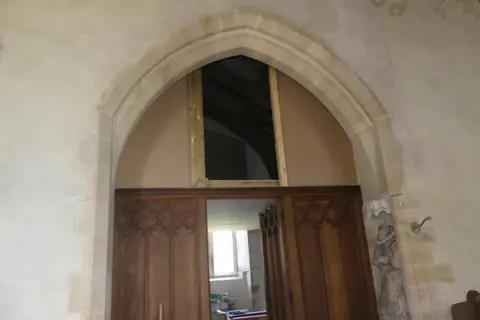
But the church worked with the Bats in Churches team to find a solution: They built an enclosed loft above the vestry.
Ecologist Phillip Parker sets up his ladder to show us the inside.
“The idea is that the bats that are in the main body of the church will live here rather than in the church itself,” he explains.
It is equipped with video surveillance cameras, allowing the team to monitor the animal’s behavior.
“What we found is that some weeks of the year there will be a hundred bats here, and then suddenly they disappear,” Parker says.
“We don’t know where they go, but they disappear for about 10 days, then they come back. And without video surveillance, we would never have known.”
 Bats in churches
A large construction project like this takes time, effort and money.
The new loft and ongoing bat monitoring cost around £50,000, funded by the Heritage Lottery Fund and other partners.
Diana Spencer says there are cheaper alternatives and grants are available through the Bat Conservation Trust.
“In a simple way, you can use sheets or blankets over areas where items might be damaged. You can apply a coat of wax to items like brass so that urine doesn’t damage it.”
She recommends anyone finding bats in a building contact the National Bat Helpline for advice.
 Bats in churches
It seems that more and more bats are seeking shelter in churches.
“They’re losing a lot of habitat, a lot of forest,” Spencer says. “And we’re also tearing down old buildings, making our homes warmer and more airtight – there are fewer places to go.”
Church patrons must learn to live alongside these creatures of the night – and some parishes are even beginning to view bats more as a treat than a trap.
“We regularly see churches having parties and events around bats,” says Spencer.
“And they can be a really, really good way to reach people, especially in the local community, who might not come to a church for a service or a prayer, but who will come and look at the bats, because people find them really, really fascinating.”


