Fossil fuel emissions rise again


Marc Poynting,Climate journalist And
Matt McGrath,Environment correspondent

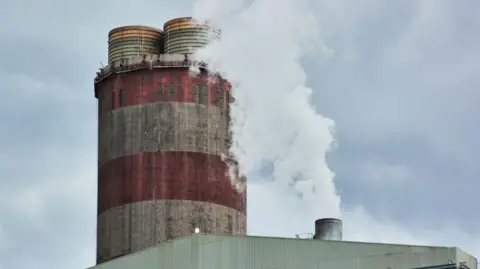 Waldo Swiegers/Bloomberg via Getty Images
Global burning of fossil fuels is expected to release more global warming carbon dioxide this year than ever before, according to new figures.
It’s another sign that efforts to combat climate change by reducing emissions are moving far too slowly to meet international goals, as countries gather in Brazil for the UN COP30 climate talks.
But emissions have grown much less quickly over the past decade as renewable energy has taken off, giving hope that the trend toward global warming can still be curbed.
And a separate analysis from clean energy think tank Ember suggests that the use of fossil fuels in electricity generation has stagnated in 2025, largely thanks to the rapid growth of solar power.
This reinforces the idea that global emissions could be close to a peak – although it’s difficult to say exactly when that might happen.
Carbon dioxide (CO2) emissions for 2025 are of course an estimate, as the year is not yet over – but they paint a mixed picture.
Emissions from fossil fuels and cement are expected to rise further to 38.1 billion tonnes of CO2, according to the Global Carbon Budget team, which includes more than 130 scientists from 21 countries.
This would be an increase of 1.1% compared to 2024.
Emissions from land use change – such as permanent deforestation – are, however, expected to be lower than last year.
This is largely due to the end of the natural El Niño weather phenomenon – which can lead to greater forest loss – but is a continuation of a longer-term trend.
This means that in total, total emissions from all human activities are expected to reach 42.2 billion tonnes of CO2 in 2025, down from 42.4 billion in 2024, albeit marginally.
What’s clearer, the team says, is that emissions have grown more slowly over the past decade – 0.3% per year – compared to 1.9% per year in the previous decade.
And over the past decade, 35 countries have significantly reduced their fossil fuel emissions while growing their economies, they say. This is almost double the number from the previous decade.
“We are not yet in a situation where emissions are decreasing [as] quickly as necessary to fight climate change, but at the same time there are many positive results [developments]” said Corinne Le Quéré, professor of climate change science at the University of East Anglia.
Emissions have increased much less quickly than before “because of this extraordinary growth in renewable energy in China and elsewhere,” she added.
Near the top?
This effect of the renewable energy boom is evidenced by emissions in the energy or electricity sector.
Electricity generated from fossil fuels is expected to stagnate or even decline slightly this year, according to think tank Ember, for the first time since the Covid-19 pandemic.
What’s unusual this year, Ember says, is that it happened as demand for electricity rose sharply, rather than resulting from an economic recession.
And this year’s additional electricity demand has been more than met by wind and, in particular, solar.
“We’ve had decades and centuries where fossil fuels were the only way to really grow our economy, and in the last decade that’s changed for the first time,” said Nicolas Fulghum, senior data analyst at Ember.
“Solar energy is growing at a record pace and faster than any electricity source in history,” he added.
What happens in the electricity sector is particularly important in the fight against climate change.
It is the highest emitting sector and is expected to play a growing role in the energy system as more people buy electric cars, heat pumps and other technologies.
“Everything that happens in the electricity sector has an outsized influence on the evolution of emissions globally,” Mr Fulghum said.
Ember is convinced that emissions from the use of fossil fuels to produce electricity are now plateauing and could begin a permanent decline in a few years.
This echoes yesterday’s message from the International Energy Agency, the global energy watchdog.
Carbon emissions from energy systems – beyond just electricity – could peak in the coming years, based on countries’ declared policies, it says.
Although there remains uncertainty about the exact timing of a peak, it would undoubtedly be a historic moment in the fight against climate change.
This would not stop warming, however, as countries would continue to add CO2 to the atmosphere – but at a slower rate.
“As long as we emit CO2, warming will continue…to stop warming we must provide [net] emissions to zero,” said Professor Pierre Friedlingstein, Chair of Mathematical Modeling of Climate Systems at the University of Exeter.
And another analysis published today on the occasion of COP30 allows us to confront reality.
The research group Climate Action Tracker estimates that warming could reach 2.6°C above pre-industrial levels by the end of the century, based on current policies – a figure that has barely changed in recent years.
“It’s very clear that we’ve never had a better chance of doing this. It’s also clear that we’ve never been in a worse situation,” said Dr Bill Hare, of the Climate Action Tracker team.
“So it’s a diabolical dilemma. Things could go very badly. We could walk away from this COP without taking appropriate action and consolidating fossil gas and oil, and we’ll be heading towards 2.5°C. [or] A warming of 3°C, that’s for sure,” he added.
“But on the other hand, the opportunity is there… to do exactly the opposite and take advantage of the dynamics of technological changes taking place on a global scale.”


:max_bytes(150000):strip_icc()/HLTH_WIWIK_Alopecia-Abby1-9fd57c80fdab4622a9e4af07b936668c.jpg?w=390&resize=390,220&ssl=1 "Alopecia Gave Me the Freedom to Be Whoever I Want")


